When is a drug not a drug? The challenging nature of ADC terminology
You know when you have made it in an industry when you can understand the acronyms, and therefore it always interests me when people start to use them casually in conversation. Use of carefully constructed capital letters that signify that you understand the subject matter and can talk with ease with like-minded scientists can go a long way to demonstrate your credibility in the field.
Antibody-drug conjugates or ADCs have taken this to a whole new level, given the field is similarly defined by this 3-letter acronym. For the uninitiated or newbies to the field, ADCs are enough of a complex modality without having to become familiar with a bunch of additional acronyms but it goes with the territory, so the quicker this new language is learned, the better.
Case in point is the recently approved Zynlonta™ which contains the SG3199 pyrrolobenzodiazepine dimer or PBD dimer for short (surely PBDD?). This PBD dimer is a payload, warhead, cargo or cytotoxin and folks use these interchangeably depending on the audience.
Payload, cargo, warhead, cytotoxin, toxin (*other descriptors) all mean the same thing – what is being conjugated. Just to add a bit of ambiguity, conjugating linkers have cleavable linkers or non-cleavable linkers embedded, so when folks say cleavable linkers, this is typically to release the payload (or *other) intracellularly and not how the linker is conjugated to the antibody.
And don’t’ confuse TOP2 with TROP2 – the former is topoisomerase II that manages DNA replication, and the latter is tumor-associated calcium signal transducer 2, a cell surface glycoprotein. In fact, TROP2 is the antigen target of the Immunomedics ADC Trodelvy® that contains the topoisomerase I inhibitor SN-38 (a TROP2-TOP1 ADC!)
The succinimidyl 4-(N-maleimidomethyl)-cyclohexane-1-carboxylate or SMCC linker is used in the conjugation of the payload (or *other) of DM1 (Drug Maytansioid 1) to trastuzumab to produce the ADC ado-trastuzumab emtansine (Kadcyla®). More accurately, SMCC is pre-conjugation, and MCC post conjugation, denoted by the loss of the succinimidyl S leaving group in the product. So the Kadcyla® ADC drug contains the drug maytansioid drug. Confusing? It starts to feel like there are too many drugs.
Outside of the standard acronym drug development toolbox, the ADC developer should be aware of key acronyms such as DAR – drug-antibody ratio which explains how many payloads (or *other) are conjugated; then there is HIC or hydrophobic interaction chromatography, a go-to analytical technique used in the characterisation of DAR for an ADC; and TDCs are THIOMAB™-drug conjugates with engineered cysteine residues that allow for site-specific conjugation and defined DAR.
In summary, you can combine these acronyms to produce an ADC as an MMC TOP2-TROP2 TDC with a DAR defined by HIC. I am beginning to sound like Adrian Cronauer. Although if you can understand this, then perhaps you are at ADC level 2.0.
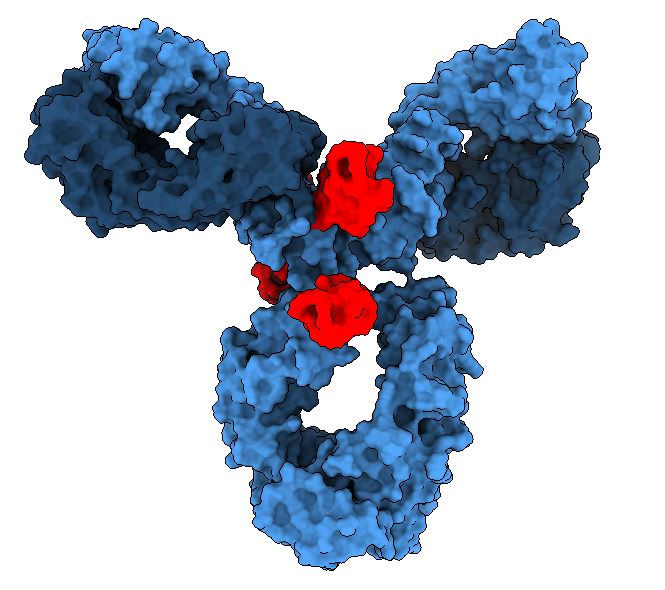
 ADCs
ADCs 